Hydroponic Tomatoes: Variety, Setup, and Harvest Guide
Grow hydroponic tomatoes at home. Cherry types harvest in 60–75 days. Covers variety selection, EC by stage, DWC, Dutch bucket, and blossom end rot fixes.
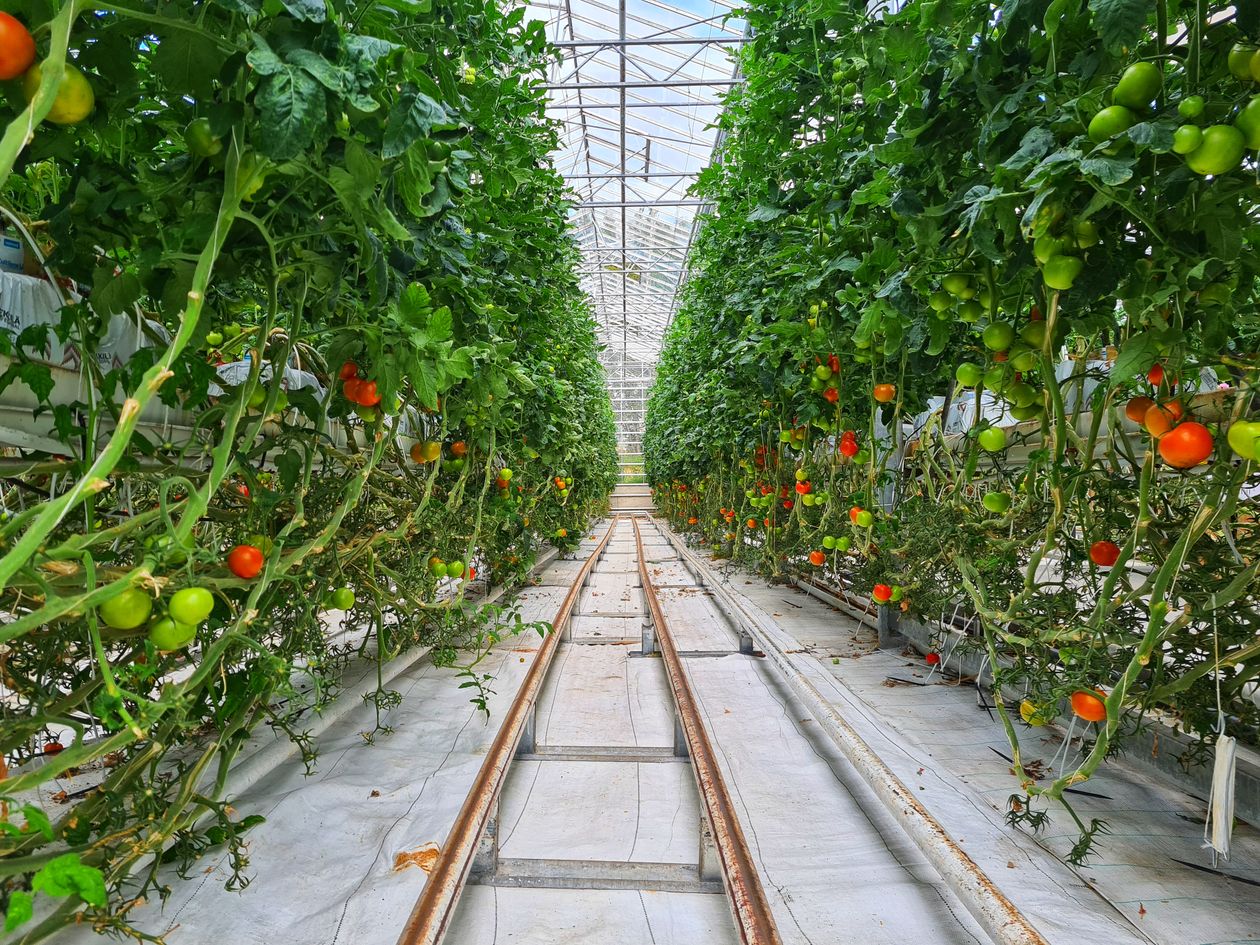
Tomatoes are the most-wanted crop in home hydroponics and the one most beginners get wrong. Most guides give you a variety name and a pH range, then stop. They skip the two things that get you fruit: matching variety to system, and adjusting nutrients at every stage.
Get those two right and you’ll have cherry tomatoes for months. Skip them and you’ll grow a leafy plant that never sets.
The short version
- Cherry varieties in DWC or Dutch bucket are the most reliable home setup. Sungold and Sweet 100 are proven performers for beginners.
- Run EC in stages: 1.2–1.5 mS/cm for seedlings, 2.0–2.5 in vegetative growth, 2.5–3.5 at fruiting. Ohio State University Extension recommends starting at 2.0 and raising to 2.4 at peak production.
- Pollinate every 2–3 days once flowers open. An electric toothbrush on the flower stem for 2–3 seconds is the most reliable method.
- Kratky doesn't work for standard tomatoes. Tiny Tim in a 5-gallon container is the one workable exception.
Which tomato variety works best in hydroponics?
Cherry and grape varieties are the right starting point. Sungold, Sweet 100, and Black Cherry offer crack resistance and short days-to-harvest that suit a home system (PMC: controlled-environment tomato guidelines).
Beefsteak and large indeterminate types need Dutch buckets, 6+ feet of ceiling clearance, and weekly pruning. Not a beginner project.
| Variety | Growth habit | Days to harvest | System fit | Notes |
|---|---|---|---|---|
| Sungold (cherry) | Indeterminate | 57–65 days | DWC, Dutch bucket | Crack-resistant; exceptionally sweet |
| Sweet 100 (cherry) | Indeterminate | 65–70 days | DWC, Dutch bucket | Very high fruit load; prune suckers weekly |
| Tiny Tim | Determinate (dwarf) | 45–55 days | Any system, Kratky possible | Best for shelves and compact setups |
| Roma | Determinate | 75–80 days | Dutch bucket | Dense flesh; prone to blossom end rot |
| Beefsteak types | Indeterminate | 85–95 days | Dutch bucket only | Needs 6+ ft clearance and a high-wire trellis |
Determinate vs indeterminate matters. Determinates top out at 3–4 feet, fruit all at once, and need minimal pruning. Indeterminates keep growing and fruiting indefinitely. Prune suckers weekly or they’ll outgrow your space (Oklahoma State University Extension).
What’s the best hydroponic system for tomatoes?
DWC and Dutch bucket are the two proven options for home growers. DWC handles 1–4 plants well and is simpler to set up. Dutch buckets, filled with coarse perlite, provide better root support for larger indeterminate varieties and scale easily to more plants.
| System | Yield potential | Root support | Complexity | Verdict |
|---|---|---|---|---|
| DWC | High | Good | Medium | Reliable for 1–4 cherry or dwarf plants |
| Dutch bucket | Highest | Excellent | Medium-high | Industry standard for vining varieties and 4+ plants |
| NFT | Medium | Limited | High | Cherry tomatoes only; root mass clogs channels in late cycle |
| Kratky | Low | Poor | Low | Not recommended for standard varieties |
NFT channels sized for lettuce can’t handle a mature tomato’s root mass. Roots dam the channel, starve the water of oxygen, and trigger rot within weeks. Kratky fails differently: peak-fruiting tomatoes drink up to two gallons daily, emptying a passive reservoir before harvest.
Dutch buckets recirculate solution through perlite and cut water use significantly. A 2024 study found soilless tomato cultivation uses 43% less water than soil (MDPI Water, 2024).
Comparing plants across EC categories and system types? See our plant library guide for a full breakdown.
How do you set up hydroponic tomatoes step by step?
- Germinate in rockwool or coco coir. Sow seeds 0.5 cm deep in pre-soaked, pH-adjusted plugs. Keep them at 21–24°C under a humidity dome. Don't add nutrients until cotyledons fully open. Seedlings run on stored seed energy for the first 5–10 days.
- Transplant when first true leaves appear. That's typically 10–14 days after germination. Move the plug carefully into your DWC net pot or Dutch bucket without disturbing the root tip.
- Start at EC 1.2–1.5 mS/cm, pH 5.8–6.2. Use a nitrogen-heavy seedling formula. Starting too high creates osmotic pressure that burns young roots before they can establish.
- Raise EC to 2.0–2.5 at weeks 3–4 as vegetative growth accelerates. Switch to a balanced NPK formula and run 16 hours of light per day.
- Stake and train from week 2. Tie the main stem to a support line every 6–8 inches. For indeterminate varieties, pinch lateral suckers from the leaf axils each week to maintain a single main leader.
- Begin pollinating when the first flowers open. See the section below. This is the step most beginners miss entirely.
- Raise EC to 2.5–3.5 at first fruit set and switch to a high-potassium, high-calcium fruiting formula. Hold this through harvest.
What’s the right nutrient schedule for hydroponic tomatoes?
Tomatoes need the highest EC of any common hydroponic crop, and the target shifts at every stage. Underfeed at fruiting and you get bland, watery fruit. Overfeed at seedling and you burn roots before the plant is strong enough to carry a fruit load.
At a glance: tomato EC and pH by growth stage
| Stage | Duration | EC (mS/cm) | pH | Key nutrient focus |
|---|---|---|---|---|
| Germination | Days 1–10 | 0 (plain water) | 5.8–6.0 | None |
| Seedling | Days 10–21 | 1.2–1.5 | 5.8–6.2 | Nitrogen-heavy formula |
| Vegetative | Weeks 3–5 | 2.0–2.5 | 5.8–6.2 | Balanced NPK |
| Flowering | Weeks 5–7 | 2.5–3.0 | 6.0–6.5 | Raise K and Ca; reduce N |
| Fruiting | Weeks 7–12 | 2.5–3.5 | 6.0–6.5 | High K and Ca; moderate P |
| End of cycle | Week 12+ | 3.0–3.5 | 6.0–6.5 | Hold; flush final 7 days |
Source: Ohio State University Extension, based on University of Arizona research by Dr. Merle Jensen. Recommends EC 2.0 dS/m at early vegetative, rising to 2.4 dS/m at peak fruiting.
A 2014 Lampung University study found peak yield at EC 3 dS/m: 120.8 g per plant (ResearchGate). EC 4 dropped output to 88.4 g; EC 5 fell to 75.5 g as osmotic stress blocked water uptake. Stay below 4.0 mS/cm: yield and blossom end rot both turn sharply negative above that.
How do you pollinate hydroponic tomatoes?
Indoor tomatoes have no bees and no wind. Pollinate manually every 2–3 days once flowers open. Pollen releases best between 11am and 2pm, when humidity is at its daily low.
Three methods that work:
- Electric toothbrush (most reliable): Touch the vibrating brush head to the flower stem directly behind the bloom for 2–3 seconds. The vibration dislodges pollen from the anther cone and deposits it on the stigma. This is the closest you’ll get to bumblebee sonication.
- Small fan (passive): Run a circulation fan directed at the plants for 4–6 hours daily. Works as a supplement, but it’s less reliable for dense flower clusters.
- Soft paintbrush: Swirl the tip gently inside the yellow anther cone to transfer pollen. Targeted and effective, but slow for multiple plants.
A successful pollination shows within 3–5 days: the yellow petals shrivel and a small green nub appears at the flower base. No nub after 5 days means the flower wasn’t pollinated and it’ll drop.
What are the most common hydroponic tomato problems?
| Symptom | Most likely cause | Fix |
|---|---|---|
| Flowers drop without setting fruit | No pollination, or air temp above 29°C sterilizing pollen | Pollinate every 2–3 days; lower ambient temperature |
| Blossom end rot (black bottom on fruit) | Calcium uptake failure from high K:Ca ratio or inconsistent watering | Fix watering consistency first; check K:Ca ratio; add Cal-Mag only after confirming pH and transpiration are in range |
| Leaves curling upward | Heat stress or EC too high for current stage | Keep reservoir below 24°C; pull EC back to stage target |
| Yellowing lower leaves | Normal nitrogen redistribution to fruit, or early root rot | Inspect roots for brown slime; see why leaves turn yellow |
| Fruit cracking | Water fluctuation: pulp expands faster than skin after a dry period | Maintain consistent irrigation; avoid large reservoir changes; harvest at breaker stage (UMass Amherst) |
| Stunted growth, no new leaves | Root bound or root rot | Inspect roots; if brown and slimy, treat immediately. See the root rot guide |
Blossom end rot is a calcium uptake failure, not a shortage. Calcium travels through the plant via the transpiration stream. High humidity blocks transpiration; high potassium competes with calcium at root uptake sites. Fix watering consistency and keep humidity below 70% before adding Cal-Mag (UGA Extension, C-938).
Hydroponic tomatoes take more attention than lettuce or basil, but they reward it. Pick a cherry variety, use DWC or a Dutch bucket, and adjust EC at every stage. Most failures come from one of three things: wrong variety, flat EC, or skipped pollination.
- Match variety to system volume before you plant anything
- Move EC up in stages — the OSU/U of A schedule is your baseline
- Pollinate every 2–3 days with a vibrating tool from first flower to last
Want to see how tomatoes compare to other fruiting crops? Check hydroponic strawberries for a similar grow profile with a shorter cycle.
Can I grow tomatoes in a Kratky system?
Not recommended for standard varieties. A mature tomato transpires up to two gallons daily at peak fruiting, emptying a passive reservoir before fruit sets. Tiny Tim dwarf determinate is the exception: it finishes in 45–55 days in a 5-gallon container.
How long do hydroponic tomatoes take to produce fruit?
Cherry and grape varieties yield their first harvest within 60–75 days from transplant. Roma and larger types take 75–90 days. Indeterminate varieties continue producing for 6–12 months if the root zone and trellising are maintained consistently.
Do hydroponic tomatoes taste different?
A 2021 peer-reviewed study from Aberystwyth University found DWC tomatoes accumulated significantly higher lycopene and beta-carotene than soil-grown counterparts (PubMed). Flavor depends mainly on EC level at fruiting and ripeness at harvest, not which system you use.
What light do hydroponic tomatoes need?
Fruiting plants need 400–600 PPFD minimum and a photoperiod of 14–18 hours under grow lights. Tomatoes have some of the highest light demands of any indoor crop. Running less than 12 hours during fruiting delays harvest and reduces fruit set significantly.
Why are my hydroponic tomato leaves turning yellow?
Lower leaf yellowing during peak fruiting is usually normal. The plant redirects nitrogen to ripening fruit. If it spreads upward or comes with leaf curl, check EC for the current stage and inspect roots for brown slime.
Sources (9)
- Ohio State University Extension, Hydroponic Nutrient Solution for Optimized Greenhouse Tomato Production, retrieved 2026-06-29, https://cfaes.osu.edu/fact-sheet/hydroponic-nutrient-solution-optimized-greenhouse-tomato-production
- PMC (National Library of Medicine), Guidelines to use tomato in experiments with a controlled environment, retrieved 2026-06-29, https://pmc.ncbi.nlm.nih.gov/articles/PMC4235429/
- PubMed, Controlled comparisons between soil and hydroponic systems reveal increased water use efficiency and higher lycopene and beta-carotene contents in hydroponically grown tomatoes (Verdoliva et al., Aberystwyth University, 2021), retrieved 2026-06-29, https://pubmed.ncbi.nlm.nih.gov/33731973/
- ResearchGate, The Effect of EC Levels of Nutrient Solution on the Growth, Yield, and Quality of Tomatoes (Solanum Lycopersicum) under the Hydroponic System, Lampung University, retrieved 2026-06-29, https://www.researchgate.net/publication/261215803_The_Effect_of_EC_Levels_of_Nutrient_Solution_on_the_Growth_Yield_and_Quality_of_Tomatoes_Solanum_Lycopersicum_under_the_Hydroponic_System
- Oklahoma State University Extension, Pruning Hydroponic Crops, retrieved 2026-06-29, https://extension.okstate.edu/fact-sheets/pruning-hydroponic-crops
- Mississippi State University Extension, Tomato Troubles: Common Problems with Tomatoes, retrieved 2026-06-29, https://extension.msstate.edu/publications/tomato-troubles-common-problems-tomatoes
- University of Massachusetts Amherst, Tomato Fruit Cracking, retrieved 2026-06-29, https://www.umass.edu/agriculture-food-environment/vegetable/fact-sheets/tomato-fruit-cracking
- University of Georgia Extension, Blossom-End Rot and Calcium Nutrition of Pepper and Tomato (C-938), retrieved 2026-06-29, https://fieldreport.caes.uga.edu/wp-content/uploads/2025/08/C-938_4.pdf
- MDPI Water, Assessment of Water Productivity and Economic Viability of Greenhouse-Grown Tomatoes under Soilless and Soil-Based Cultivations, 2024, retrieved 2026-06-29, https://www.mdpi.com/2073-4441/16/7/987